


COP31’s target to increase electricity’s share of global final energy consumption to 35 percent by 2035 could drive annual investment in power grids to $930 billion, creating substantial opportunities for transmission developers, transformer manufacturers and energy storage companies. However, grid connection delays, equipment shortages, lengthy permitting processes and financing constraints threaten progress.
At COP31 in Antalya, Turkiye, the Turkish presidency is advancing its 35-by-35 electrification initiative, seeking to increase electricity’s share of global final energy consumption from approximately 23 percent to 35 percent by 2035.
The official COP31 electrification announcement from UN Climate Change places electrification among the presidency’s principal energy transition priorities.
The International Energy Agency’s (IEA) September 2026 electrification assessment estimates that commercially available technologies could cost-effectively increase electricity’s share to 33 percent by 2035, approaching COP31’s more ambitious target.
Achieving this expansion requires coordinated investment in electricity generation, transmission networks, substations, transformers, distribution infrastructure and battery storage.
Global Grid Investment Must Double to $930 Billion Annually
The IEA’s 2026 Electrification Special Report estimates that annual global grid investment must increase from approximately $450 billion in 2025 to $930 billion by 2035 under a high-electrification scenario with a net-zero-aligned electricity mix.
The projected increase represents $480 billion in additional annual grid spending, equivalent to 107 percent above the 2025 investment level.
Annual electricity generation investment would increase from $960 billion to approximately $1.5 trillion, while battery storage investment would rise from $80 billion to $125 billion.
Combined annual investment in generation, grids and storage would approach $2.5 trillion by 2035, compared with approximately $1.5 trillion in 2025.
These projections quantify the investment required under the IEA scenario, rather than an established financing deficit or confirmed capital commitments.
More Than 2,500 GW of Projects Await Grid Connections
The IEA’s Electricity 2026 grid analysis identifies more than 2,500 GW of renewable generation, storage and large electricity-consuming projects stalled in grid connection queues worldwide.
The agency estimates that annual grid investment must increase approximately 50 percent from the roughly $400 billion baseline used in its electricity-market assessment by 2030.
Transmission development presents a major obstacle. New transmission infrastructure typically requires five to 15 years for planning, permitting and construction, compared with one to five years for solar and wind projects and one to three years for data centers.
Prices for critical grid components have nearly doubled over five years, increasing procurement costs and complicating utility investment plans.
The IEA estimates that grid-enhancing technologies and targeted network upgrades could release sufficient capacity to connect 450–700 GW of advanced-stage projects, reducing delays without waiting for entirely new transmission corridors.
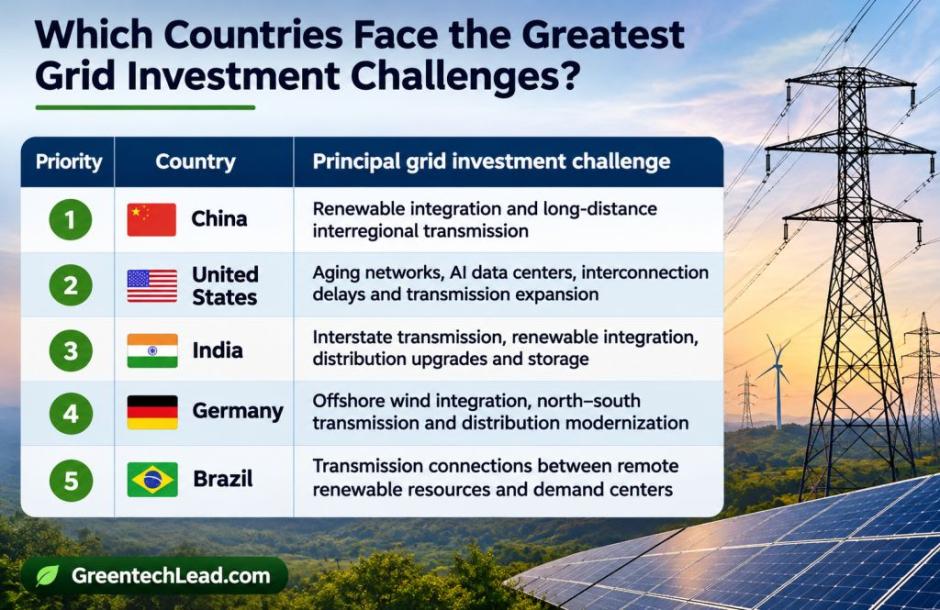
Which Countries Face the Greatest Grid Investment Challenges?
China, the United States, India, Germany and Brazil face substantial electricity network expansion requirements, although comparable country-level financing shortfall estimates are unavailable.
The following assessment identifies major investment priorities rather than ranking countries by verified funding deficits.
China faces the challenge of integrating extensive renewable generation capacity while strengthening long-distance transmission between electricity-producing and consuming regions.
The United States must modernize aging networks, accommodate rising AI data-center electricity demand and address lengthy transmission permitting and grid interconnection processes.
India requires major investments in interstate transmission corridors, substations, transformers and distribution infrastructure to accommodate renewable capacity additions.
Germany needs additional north–south transmission capacity to transport offshore wind generation and other renewable electricity to industrial demand centers.
Brazil must expand transmission networks connecting geographically dispersed renewable projects with major electricity-consuming regions.
These requirements indicate potential equipment demand but cannot be classified as confirmed orders or financing gaps without supporting project-level disclosures.
Siemens Energy, GE Vernova and Hitachi Energy Expand Grid Businesses
Power equipment manufacturers are already benefiting from rising orders for transformers, high-voltage equipment and transmission infrastructure.
According to Siemens Energy’s November 11, 2026 financial results, its Grid Technologies division secured approximately €24 billion in fiscal 2026 orders, increasing 14.5 percent. Siemens Energy’s company-wide order backlog reached €164 billion, reflecting demand across grid equipment and power generation businesses.
GE Vernova’s third-quarter 2026 financial results filed with the SEC reported Electrification orders of $5.4 billion and revenue of $3.9 billion, with revenue increasing 51 percent year over year.
Its Electrification equipment backlog reached $42.2 billion, up 60 percent, indicating substantial contracted demand for electrical infrastructure.
GE Vernova also announced an approximately $9 billion agreement to acquire Trench Group, expanding its high-voltage grid equipment portfolio.
Hitachi Energy is strengthening transformer manufacturing capacity in India through a ₹2,000 crore investment in a large power transformer factory in Vadodara.
According to Hitachi Energy’s manufacturing expansion announcement, the facility is scheduled for completion in FY2028 and will serve transmission, HVDC, power generation and data-center applications.
Schneider Electric and ABB are also positioned to capture demand for distribution equipment, grid automation, electrification and power management systems. However, comparable 2026 grid-specific order figures are not established in this assessment.
India Requires ₹7.93 Lakh Crore in Transmission Investment
India represents one of the largest potential markets for transmission equipment and grid infrastructure suppliers.
Central Electricity Authority estimates cited by Hitachi Energy indicate that India requires approximately ₹7.93 lakh crore in transmission investment to integrate more than 900 GW of non-fossil electricity capacity by 2035.
This estimate covers transmission infrastructure, excluding the full investment required for renewable generation, battery storage and distribution modernization.
India’s principal execution challenges include synchronizing transmission commissioning with renewable project development, expanding domestic transformer production and securing timely deliveries of high-voltage equipment.
Delayed grid infrastructure could prevent completed renewable projects from supplying electricity, increasing financing costs and reducing returns for developers.
Can COP31 Mobilize $930 Billion in Annual Grid Investment?
COP31’s 35 percent electrification ambition depends on whether governments, utilities and private investors can accelerate grid investment alongside electricity generation and storage deployment.
The IEA’s projected $930 billion annual grid investment requirement by 2035, compared with approximately $450 billion in 2025, establishes the scale of additional spending needed.
However, the $480 billion difference represents a scenario-based annual investment requirement, not a verified shortfall against existing financial commitments.
Progress will depend on approved utility capital expenditure, regulated investment returns, transmission financing, equipment manufacturing capacity and faster project approvals.
The most meaningful indicators will be transmission projects achieving financial close, transformer factories increasing output, new grid infrastructure entering service and renewable projects securing operational connections.
For COP31, the decisive test is whether electrification commitments translate into financed, manufactured and commissioned electricity infrastructure before 2035.
BABURAJAN KIZHAKEDATH