
Bangladesh could reduce peak electricity demand by 2,590 megawatts (MW), save $730 million annually in electricity costs and avoid more than $4 billion in future coal-fired power plant investments by replacing conventional household fans with energy-efficient Brushless Direct Current (BLDC) fans, according to a November 2026 report from the Institute for Energy Economics and Financial Analysis (IEEFA).
The report, Household Space Cooling in Bangladesh: Role of Energy-Efficient Fans, highlights the potential of energy-efficient appliances to address Bangladesh’s growing electricity demand, power shortages and dependence on imported fossil fuels.
Household cooling fans account for up to 5,212 MW of summer electricity demand, while energy-efficient BLDC fans represent just 1.4 percent of household fans.
A nationwide transition could reduce annual electricity consumption by approximately 6,913 gigawatt-hours (GWh), generating savings of BDT89.87 billion, equivalent to $730 million.
Bangladesh Electricity Demand Reaches 19,027 MW
Bangladesh’s peak electricity demand reached 19,027 MW on August 27, 2026, increasing 11.27 percent from 17,099 MW recorded in July 2025.
Despite having installed electricity generation capacity of 29,143 MW, Bangladesh continues to experience substantial power shortages.
The electricity supply shortfall reached 3,757 MW in August 2026, highlighting challenges associated with fuel availability, generation costs and rising consumption.
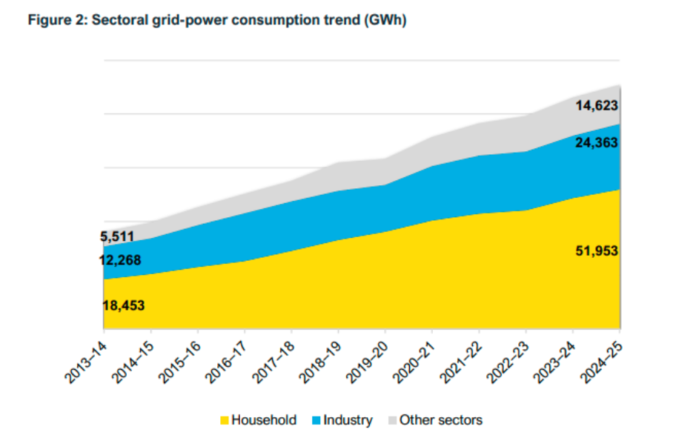
Households represent Bangladesh’s largest electricity-consuming segment, accounting for more than 50 percent of grid-based electricity consumption.
Household electricity consumption reached 51,953 GWh in FY2024-25, compared with industrial consumption of 24,363 GWh.
Other sectors, including commercial establishments, agriculture, hospitals and educational institutions, consumed 14,623 GWh.
These figures demonstrate why improving household appliance efficiency could significantly influence national electricity demand.
Household Fans Consume 13,916 GWh Annually
IEEFA estimates that household cooling fans consume approximately 13,916 GWh of electricity annually.
Electricity demand from household fans varies significantly throughout the day.
Between 7 AM and 7 PM, household fans generate approximately 3,362 MW of electricity demand.
Demand increases to 5,212 MW between 7 PM and 11 PM, when residential cooling requirements are highest.
Between 11 PM and 7 AM, electricity demand from fans remains elevated at approximately 4,855 MW.
The report estimates that replacing conventional fans with BLDC technology could reduce evening electricity demand by approximately 2,590 MW.
Potential reductions during other periods include 2,415 MW overnight and 1,670 MW during daytime hours.
These figures represent separate time-of-day savings estimates rather than cumulative reductions.
BLDC Fans Can Reduce Electricity Consumption by 50 Percent
Conventional ceiling fans in Bangladesh typically consume approximately 70 watts of electricity, compared with around 35 watts for energy-efficient BLDC fans.
Replacing conventional fans with BLDC models could therefore reduce electricity consumption per fan by approximately 50 percent under the study’s assumptions.
IEEFA surveyed 435 households across 26 districts to understand fan ownership, operating patterns and consumer awareness.
Households reported owning an average of 2.2 to 5.1 fans, depending on income levels.
During summer, households operate between two and 3.4 fans at maximum usage.
Average daily operating hours range from 10.5 hours among lower-income households to approximately 12.5 hours among higher-income households.
The study estimates that approximately 98.6 million inefficient household fans could be replaced through a nationwide programme.
Bangladesh Could Avoid $4 Billion in Coal Power Investments
One of the report’s most significant findings concerns potential savings in electricity generation infrastructure.
IEEFA estimates that reducing peak electricity demand by 2,590 MW could avoid more than $4 billion in investment in additional coal-fired power generation capacity.
The estimate is based on capital expenditure associated with comparable coal power projects in Bangladesh.
Replacing inefficient household fans could cost approximately $4 billion before procurement-related savings.
However, a nationwide bulk procurement programme achieving a 25 percent reduction in fan prices could reduce investment requirements to approximately $3 billion for lower-priced BLDC models.
This suggests that avoided electricity generation investments could potentially offset the cost of a national energy-efficient fan replacement programme.
The transition could also reduce fuel consumption, electricity generation costs and pressure on the national grid.
High BLDC Fan Prices Limit Adoption
Despite their potential benefits, energy-efficient BLDC fans have achieved limited market penetration in Bangladesh.
The IEEFA survey found that approximately 98.6 percent of household fans remain energy inefficient.
Conventional ceiling fans generally cost around BDT2,000, equivalent to approximately $16.
In comparison, BLDC fans cost between BDT5,000 and BDT6,300, equivalent to approximately $41–$51.
The substantial price difference represents a major obstacle for low-income households.
Approximately 40 percent of Bangladeshi households earn BDT25,000 or less per month, according to the report’s estimates.
Without financial assistance, the estimated payback period for BLDC fans among low-income households ranges from 7.7 to 9.6 years.
For households in higher-income categories, payback periods fall below six years because of higher electricity consumption and bills.
96 Percent of Households Willing to Adopt BLDC Fans
Consumer interest in energy-efficient fans is considerably stronger than current adoption levels.
The IEEFA survey found that 96.1 percent of respondents expressed willingness to gradually replace conventional fans with energy-efficient models after learning about their electricity-saving benefits.
However, approximately 75 percent of surveyed households lacked information about the market availability of BLDC fans, while another 6 percent were unaware of the technology.
The study also found that 18 percent of households considered energy-efficient fans unaffordable.
Regarding financing preferences, approximately 64 percent of respondents indicated that they would purchase BLDC fans using their own funds.
Another 12 percent preferred instalment-based payment options, while 24 percent said they would require government financial assistance.
These findings suggest that consumer education, affordable financing and lower product prices could accelerate adoption.
Energy-Efficient Fans Could Reduce Carbon Emissions
The transition to energy-efficient fans could support Bangladesh’s climate and energy security objectives.
IEEFA identifies potential carbon dioxide emission reductions of approximately 86 million tonnes through the replacement of inefficient household fans.
The report recommends exploring carbon revenue mechanisms to help finance the transition.
Revenue generated through eligible carbon-credit programmes could potentially reduce BLDC fan purchase prices, particularly for lower-income consumers.
The report also highlights India’s experience with bulk procurement of energy-efficient LED lighting.
India’s programme demonstrated that large-scale purchasing could substantially reduce appliance prices, with LED bulb costs declining by approximately 87 percent.
Bangladesh could adopt a similar approach to improve BLDC fan affordability.
Government Support Could Accelerate Energy Efficiency
IEEFA recommends developing a coordinated national programme involving bulk procurement, consumer awareness, energy-efficiency standards, product labelling and financial assistance.
The Sustainable and Renewable Energy Development Authority (SREDA) should finalise standards and labelling requirements for household fans.
The report also proposes establishing a national-level energy service company, or super ESCO, to coordinate procurement, financing and implementation.
Electricity bill-based financing could allow households to purchase energy-efficient fans through instalments rather than making large upfront payments.
Effective quality standards and monitoring would also be necessary to prevent the distribution of substandard appliances.
Bangladesh’s growing electricity demand, imported fuel dependence and recurring power shortages have increased the importance of demand-side energy management.
IEEFA’s findings indicate that replacing inefficient household fans could deliver substantial electricity savings without requiring additional generation capacity.
The estimated annual savings of 6,913 GWh, potential peak demand reduction of 2,590 MW and avoided investments exceeding $4 billion demonstrate the scale of the opportunity.
For Bangladesh’s electricity utilities, policymakers and appliance manufacturers, energy-efficient fans offer an opportunity to improve power reliability, reduce electricity costs and limit future infrastructure expenditure.
