
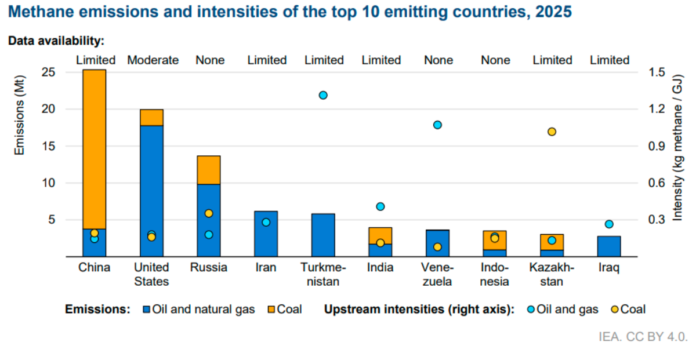
India remains one of the world’s largest methane emitters from the energy sector, driven mainly by coal mining, oil and gas operations, and traditional biomass use for cooking, according to the International Energy Agency’s Global Methane Tracker 2026.
The report estimates that India emitted around 6-7 million tonnes (Mt) of methane from fossil fuel operations in 2025, placing the country among the top global emitters alongside China, the United States, Russia, Iran and Turkmenistan. India’s methane emissions originate largely from coal mining activities, while emissions intensity in India remains below the global average for coal-producing nations.
The IEA report said nearly 150 Mt of methane was emitted globally from the energy sector in 2025, with coal production responsible for 39 Mt, oil operations for 44 Mt, and natural gas activities for close to 34 Mt. Bioenergy and traditional biomass combustion added another 20 Mt globally.
India’s energy transition strategy is increasingly important because methane is responsible for nearly 30 percent of the rise in global temperatures since the Industrial Revolution. Atmospheric methane concentrations are now 2.7 times higher than pre-industrial levels.
Coal remains the biggest source of methane emissions in India’s energy sector. However, the IEA noted that India, Indonesia and Australia record coal methane intensities that are well below the global average, reflecting improvements in mining efficiency and operational standards.
India is also among the countries monitored through advanced methane satellite systems. MethaneSAT data cited by the IEA showed India’s methane intensity from oil and gas operations remained below 0.5 kilograms of methane per gigajoule (kg/GJ), lower than several major producing nations.
The report highlighted that around 70 percent of global fossil fuel methane emissions can be reduced using existing technologies, while more than 35 Mt of emissions globally could be avoided at no net cost because captured methane can be sold as fuel.
For India, methane reduction presents significant opportunities in coal mine methane capture, leak detection and repair programs, improved oil and gas infrastructure, and cleaner cooking technologies. The IEA stressed that traditional biomass cooking and heating continue to contribute heavily to methane emissions across developing economies, including India.
Globally, incomplete combustion of traditional biomass used for cooking and heating generated around 18 Mt of methane emissions in 2025. Expanding access to LPG, electricity, improved biomass stoves, and clean biofuels could significantly reduce emissions while improving health and economic outcomes.
India has also introduced methane-focused policies as part of broader climate initiatives. Although India is not part of the Global Methane Pledge, the country is increasingly strengthening emissions monitoring and adopting cleaner energy systems to align with long-term climate goals.
The IEA emphasized that rapid methane mitigation is among the fastest and cheapest ways to slow global warming. If all countries adopted best practices similar to Norway’s low-emission oil and gas standards, global methane emissions from oil and gas operations could decline by more than 90 percent.
BABURAJAN KIZHAKEDATH
