
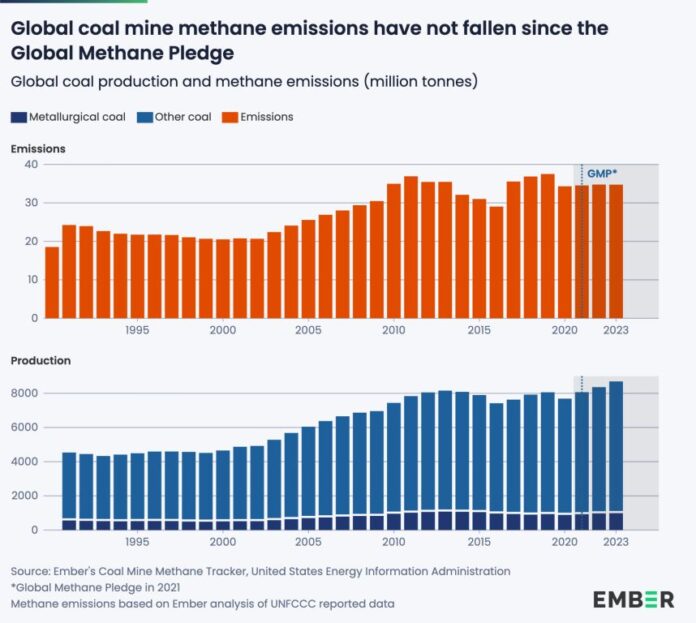
Global coal mine methane (CMM) emissions have remained largely unchanged at around 35 million tonnes in 2023, even as global coal production increased by 8 percent since 2021, exposing a major gap in climate action, according to a new report by Ember.
The Global Coal Mine Methane Review, covering 73 coal-producing countries and integrating reported data, independent estimates and satellite observations, reveals that methane emissions from coal mining have failed to decline since the launch of the Global Methane Pledge in 2021. The pledge targets a 30 percent reduction in global methane emissions by 2030, but emissions instead rose marginally by 0.6 percent between 2021 and 2023.
Methane remains a critical climate risk due to its high warming potential, trapping nearly 80 times more heat than carbon dioxide over a 20-year period. Coal mining alone accounts for roughly one-third of fossil fuel-related methane emissions, making it a key driver of near-term global warming.
The report — prepared by Ember’s Rebekah Horner and Nishant Bhardwaj — highlights data gaps and underreporting. Only 23 of the 73 coal-producing countries reported methane emissions in 2023, leaving about 31 million tonnes unreported. As a result, around 89 percent of global coal mine methane emissions were not captured in official UNFCCC inventories, significantly weakening policy response and accountability.
Further compounding the issue, 99 percent of reported coal production relies on generic emission factors rather than direct, mine-level measurements, raising concerns about the accuracy of global emissions estimates.
Methane emissions are highly concentrated geographically. Nearly 94 percent originate from just seven countries – China, the United States, Russia, India, Australia, Poland and Ukraine. China alone contributes about 76 percent of global coal mine methane emissions, making it central to any global mitigation strategy.
Though some countries report declining methane emissions per tonne of coal produced, this trend is largely driven by methodological changes, shifts to surface mining and updated reporting practices rather than widespread deployment of methane abatement technologies.
Despite limited progress, the report identifies strong potential for rapid emissions reduction. Existing technologies could cut 54 percent to 63 percent of global coal mine methane emissions by 2030. Around 12 percent of this reduction potential is achievable at no net cost, while overall mitigation costs remain significantly lower than annual coal industry profits.
Ventilation air methane, a major emissions source in underground mining, can be reduced using proven technologies such as regenerative thermal oxidisers. In addition, methane captured through drainage systems can be reused as fuel, creating new revenue streams and improving project economics.
Rebekah Horner, Coal Mine Methane Data Analyst at Ember, said that underreporting continues to mask the true scale of emissions, even though practical and cost-effective solutions are already available for deployment.
The report also highlights coal mine methane as an untapped energy resource. Around 15 billion cubic metres of methane could be captured annually from coal mines, equivalent to nearly one-eighth of the 112 billion cubic metres of LNG transported through the Strait of Hormuz in 2025, offering both climate and energy security benefits.
Satellite monitoring is improving but remains insufficient. While 71 percent of coal production occurs in regions suitable for satellite detection, only about 10 percent has been observed, pointing to major gaps in emissions tracking and verification.
Nishant Bhardwaj, Coal Mine Methane Programme Director at Ember, emphasized that global methane targets will not be achieved unless coal mine methane is directly addressed, describing it as one of the fastest and most actionable opportunities to deliver immediate climate benefits.
Coal mine methane remains a major blind spot in global climate policy. Strengthening measurement, reporting and verification systems, alongside scaling proven abatement technologies, could unlock significant emissions reductions this decade while delivering both environmental and economic gains, according to the Ember report.
BABURAJAN KIZHAKEDATH
