
Meta Platforms has outlined a data-driven sustainability strategy in its 2025 Sustainability Report, focusing on climate action, water stewardship, supply chain decarbonization, and biodiversity.
Rachel Peterson, Vice President of Infrastructure Data Centers at Meta Platforms, said: “By the end of 2024, more than 50% of our owned data center campus footprint was planned, installed, or preserved to intentionally support local, native, biodiverse habitats. That equals more than 4,000 acres.”
The digital media company is aligning its environmental goals with rapid AI-driven infrastructure expansion, aiming to decouple emissions growth from increasing data center demand, Blair Swedeen, Global Head of Net Zero and Sustainability at Meta Platforms, said in the Sustainability Report 2025 released in September 2025.
Meta’s long-term ambition is to achieve net zero emissions across its entire value chain by 2030 while becoming water positive globally within the same timeframe. Interim targets include reducing Scope 1 and 2 emissions by 42 percent by 2031 from a 2021 baseline and ensuring Scope 3 emissions do not exceed 2021 levels. The company is also targeting supplier engagement, aiming for at least two-thirds of suppliers to adopt science-based emission targets by 2026.
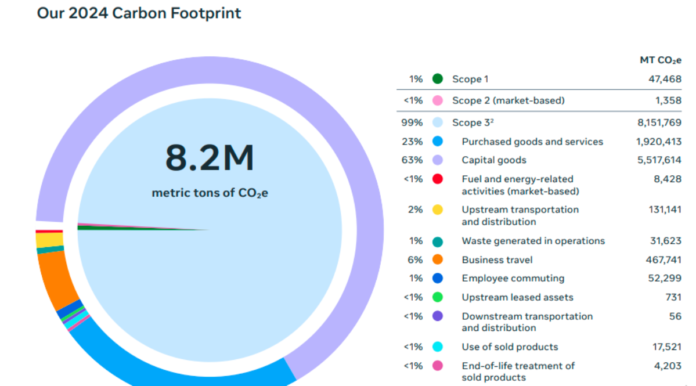
Meta has maintained net zero emissions for its operations since 2020 by matching 100 percent of electricity consumption with renewable energy. However, its total emissions footprint remains heavily influenced by its value chain. In 2024, Meta reported 8.2 million metric tons of CO2e emissions, with 99 percent attributed to Scope 3 sources. Despite this, the company achieved a 19 percent reduction in Scope 3 emissions compared to its 2019 baseline.
The company’s clean energy strategy continues to scale significantly. Meta has contracted more than 15 gigawatts of renewable energy capacity globally, supported by a portfolio of 128 projects, of which 89 are operational. Since 2021, these initiatives have helped reduce 23.8 million metric tons of CO2e, including 6 million metric tons from operational emissions and 1.4 million metric tons from value chain emissions in 2024 alone.
Meta is also investing in next-generation energy infrastructure to support long-term sustainability. This includes nuclear energy partnerships targeting between 1 gigawatt and 4 gigawatts of new capacity in the United States, alongside a 20-year power purchase agreement for 1,121 megawatts of nuclear energy. In addition, the company is deploying battery storage systems, including 100 megawatts of capacity, to improve grid reliability and support renewable integration.
Supply chain emissions remain a priority area. Meta expanded its supplier engagement program from 39 suppliers in 2021 to 183 in 2024, now covering over half of supplier-related emissions. By 2024, 48 percent of suppliers, based on emissions contribution, had adopted science-based targets, showing measurable progress toward its 2026 goal. In parallel, the company’s responsible supply chain program now covers a majority of high-impact suppliers, with growing alignment toward climate targets.
Water stewardship is another critical pillar of Meta’s sustainability agenda. The company has supported more than 40 water restoration projects since 2017, restoring 1.6 billion gallons of water in 2024, with the potential to reach 2.9 billion gallons annually. Meta has already achieved water positive status in multiple data center communities and continues to expand conservation initiatives in high-stress regions.
Meta is also advancing biodiversity and circularity initiatives across its global footprint. More than 50 percent of its data center campuses, covering over 4,000 acres, are preserved or designed to support biodiversity. Circular economy efforts include reusing hardware components, increasing recycled materials usage, and achieving an 80 percent waste diversion rate at data centers.
The company’s sustainability strategy is closely integrated with its AI growth roadmap. Meta is investing in next-generation data center designs that use 31 percent less steel and 45 percent less carbon-intensive concrete. It is also leveraging AI for emissions tracking, optimization, and climate research, including initiatives such as datasets for direct air capture innovation. Overall, Meta Platforms is combining large-scale renewable energy procurement, supplier decarbonization, infrastructure innovation, and AI-enabled efficiencies to support its net zero by 2030 ambition, while scaling the digital infrastructure required for the future of artificial intelligence.
BABURAJAN KIZHAKEDATH
