
China’s electric vehicle (EV) and energy storage system (ESS) markets are experiencing notable price shifts, and consumers are beginning to feel the impact.
According to TrendForce’s latest “Lithium Battery Industry Chain Monthly Price Report,” November 2025 saw strong demand in the EV battery market, driven by automakers’ aggressive year-end stocking strategies, despite the typical off-season slowdown.
The surge in demand has led to higher costs for essential battery materials, including cathodes, electrolytes, copper, and aluminum foil. NCM cells, especially cobalt-rich varieties, experienced the largest price increases.
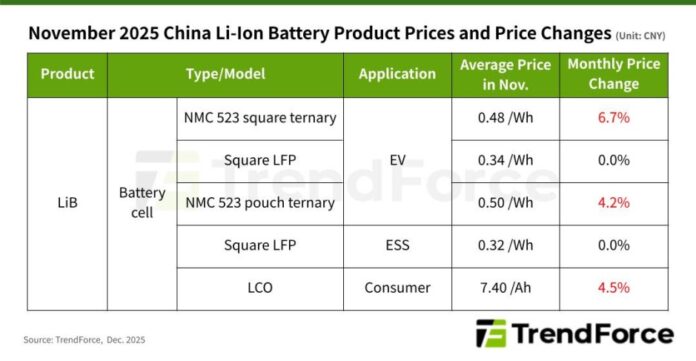
Average NCM square cells reached CNY 0.48/Wh, up 6.7 percent month-on-month, while NCM pouch cells averaged CNY 0.50/Wh, up 4.2 percent. LFP square cells remained stable at CNY 0.34/Wh. While December demand may ease slightly as automakers complete their stocking, material cost inflation is expected to keep EV cell prices trending upward.
For ESS batteries, prices held steady in November due to strong demand and full order books. Large-capacity cells exceeding 500 Ah are moving toward mass deployment, with companies like CATL already shipping gigawatt-hour scale batteries. TrendForce predicts the share of 500+ Ah ESS products will continue to rise in 2026, supporting stable pricing. However, continued increases in raw-material costs may drive modest ESS price hikes over the coming months.
Consumers may also notice the effect of sharply rising lithium, cobalt, and other essential metals. Cobalt prices, for instance, have jumped more than 140 percent from their annual low due to changes in export policies in the Democratic Republic of the Congo. Other critical materials, such as LiPF₆ and vinylene carbonate (VC), surged 230 percent and 260 percent, respectively, from July to November 2025.
Looking ahead to 2026, TrendForce expects healthy demand for both EV and ESS batteries. Battery material suppliers have announced price adjustments for cathodes, anodes, separators, and electrolytes, signaling that EV cell prices are likely to rise modestly in the new year. For consumers, this translates to a potential increase in the cost of EVs and home energy storage solutions, emphasizing the importance of planning purchases strategically.
China’s EV and ESS battery industry continues to see strong growth, driven by robust domestic demand and expanding global exports.
CATL remains the dominant player, leading both the domestic and international markets in EV battery installations, with its production scale supported by strong adoption of lithium iron phosphate (LFP) and emerging sodium‑ion batteries.
BYD, as a vertically integrated EV and battery manufacturer, is rapidly increasing production to supply both its own EVs and external contracts, narrowing the market share gap with CATL.
Other notable Chinese battery makers include CALB, Gotion High‑Tech, EVE Energy, and SVOLT, each expanding production in specific segments and investing in technology differentiation to maintain competitiveness.
China’s overall EV battery output reached approximately 1,122 GWh in the first nine months of 2025, marking a year‑on‑year increase of around 44 percent, with LFP batteries accounting for nearly half of installations, helping control costs and boost ESS adoption. Oversupply remains a challenge, putting pressure on margins and prompting consolidation among smaller players.
Average lithium‑ion battery pack prices fell to around $108 per kWh globally in 2025, with Chinese prices often lower due to large-scale production and cost-efficient chemistries, while stationary storage battery packs dropped to about $70 per kWh.
China’s battery exports have surged, contributing significantly to global supply, although trade and tariff discussions with regions like the EU may impact future pricing and production strategies. Overall, CATL and BYD dominate the market, while other manufacturers like CALB, Gotion, EVE, and SVOLT expand strategically to capture niche segments and benefit from the growing EV and ESS demand.
With EV adoption accelerating and ESS solutions gaining popularity, staying informed about battery price trends will help consumers make better decisions and navigate a market that continues to evolve rapidly.
Baburajan Kizhakedath
