
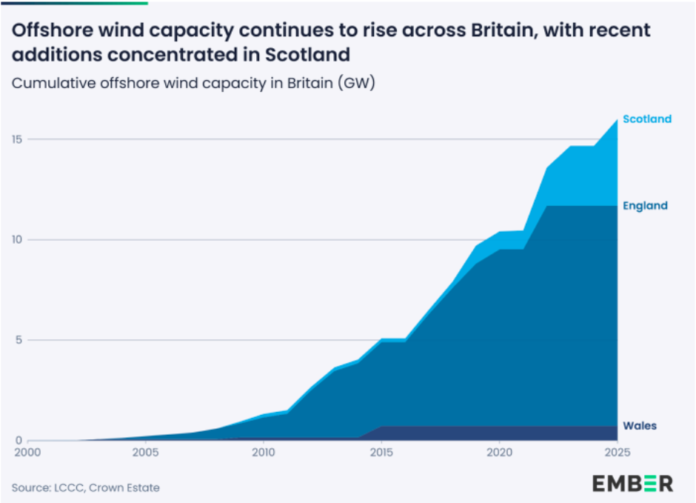
The latest report on the UK offshore wind industry highlights 25 years of growth, engineering progress and national re-industrialisation. From the first turbines at Blyth in 2000 to the world’s largest wind farms now under construction, Britain has built one of the strongest offshore wind ecosystems globally.
Frankie Mayo Senior Energy Analyst – UK, Ember, said: “By 2025, Britain has 16,000 MW of offshore wind, 34,000 MW of gas power and 0 MW of coal power following the successful phase-out in 2024.”
Here are the ten most important insights from the new report.
Offshore wind now generates 17 percent of UK electricity
Offshore wind has become the second largest power source in Britain. With 16 gigawatts of operational capacity, it generates enough clean power to meet the annual demand of 16 million homes.
Employment has expanded to 40,000 jobs
The wind energy supports around 40,000 workers, including 7,000 new jobs added in the last two years. Roles range from turbine technicians and cable engineers to key positions in finance, legal services and supply chain operations.
Britain operates 47 offshore wind farms
Twenty five years after Blyth, the country has 47 operational offshore wind farms with 2,878 turbines installed. Seven new projects are under construction and five more are in preparation, together representing 12 gigawatts.
Turbine technology has scaled dramatically
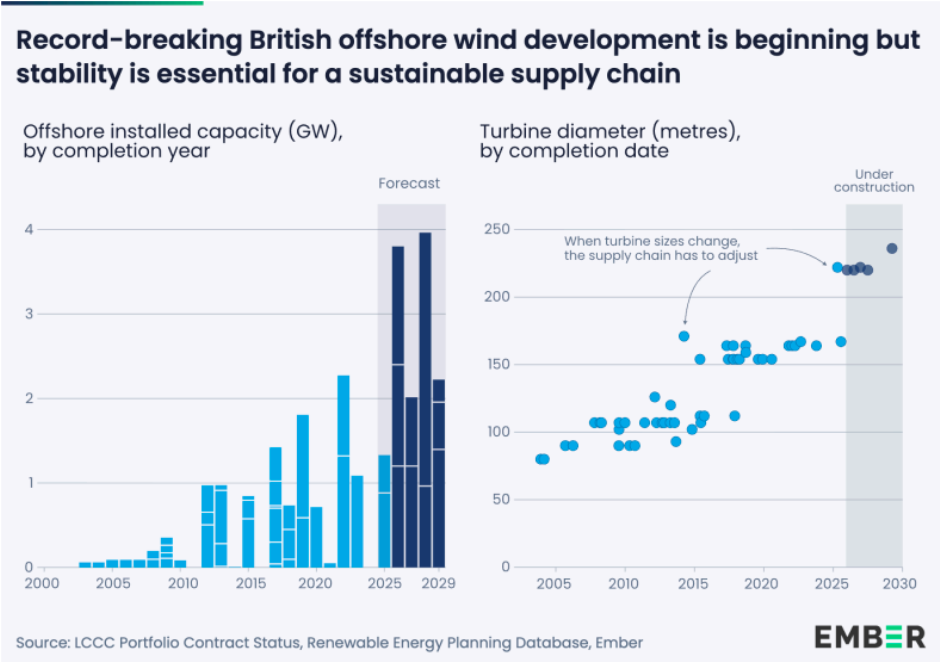
Modern blades sweep an area ten times larger than those installed at Blyth in 2000. A single turbine at Moray West generates more power than the entire original Blyth wind farm. Larger turbines have created new engineering challenges but also unlocked massive output gains.
Ports are now critical industrial hubs
Coastal regions across Britain have become essential to construction and maintenance. Investments at ports like Hull, Grimsby, Inverness and Tyne have supported thousands of jobs. The UK government has committed major funding to deepen capacity at Cromarty Firth and Port Talbot.
Britain leads the world in offshore wind policy
The country’s Contracts for Difference scheme has become a global model for renewable energy support. Thirteen countries have adopted similar two-way pricing mechanisms. During the 2022 to 2023 gas price spike, UK wind farms paid millions back to consumers.
The world’s largest wind farms are being built in British waters
Hornsea 1 was the first offshore wind project globally to exceed one gigawatt. Hornsea 2 is now the world’s largest at 1.3 gigawatts. Dogger Bank, coming online from 2026, will reach 3.6 gigawatts and will be the first UK project to use high-voltage DC transmission.
Supply chain pressures require new national manufacturing
Rapid scale expansion has created bottlenecks in blades, cables, foundations and vessels. The Offshore Wind Industrial Growth Plan identifies advanced blades, deep-water foundations and next-generation cables as priority areas for UK manufacturing expansion.
Standardisation could reduce costs and accelerate innovation
Frequent increases in turbine size reduce opportunities for learning across projects and create logistical challenges. European standardisation efforts, backed by major manufacturers, aim to stabilise turbine specifications to strengthen investor confidence and improve efficiency.
Blyth remains at the heart of future development
The birthplace of UK offshore wind is still a centre for innovation. The original turbines have been decommissioned and repurposed for training. New projects like Sofia and an advanced demonstration wind farm are driving testing of floating foundations and novel installation methods. The expanded ORE Catapult site now houses world-class blade, grid and extreme-condition testing facilities.
Baburajan Kizhakedath
