
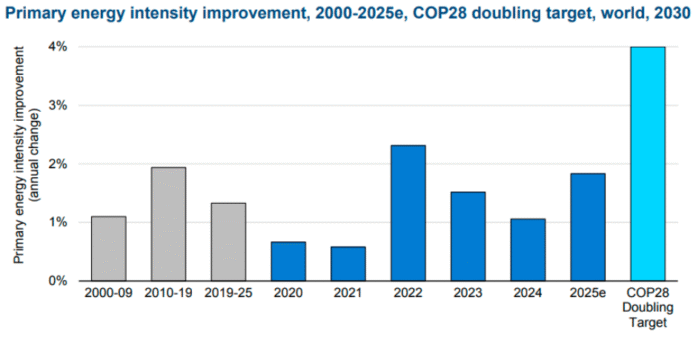
Global energy efficiency is expected to improve by 1.8 percent in 2025, up from around 1 percent in 2024. This signals moderate progress, but the world remains far from achieving the COP28 ambition of a 4 percent annual improvement by 2030. The latest IEA report highlights where momentum is building and where major gaps persist. Below is a summary of the ten most important takeaways.
1. Global efficiency improvement rises to 1.8 percent in 2025
Primary energy intensity – the key metric for efficiency – is set to grow at its fastest pace since 2019. The improvement remains far below the levels required to stay on track for 2030 goals.
2. China and India lead efficiency gains
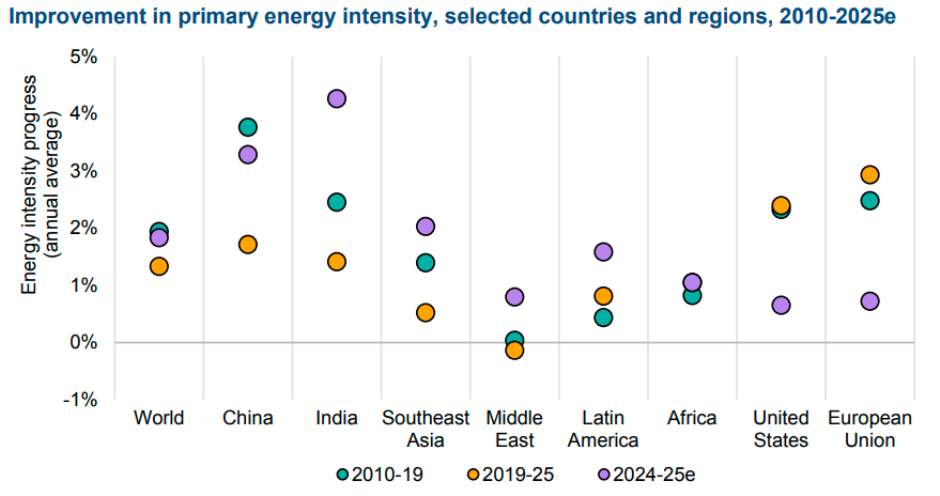
Energy intensity progress in 2025 is expected to exceed 3 percent in China and 4 percent in India. These rates are well above their averages since 2019 and show strong momentum in major emerging economies.
3. United States and European Union see slower progress
Efficiency improvement is set to fall below 1 percent in both the United States and the European Union after several years of faster gains following the energy crisis.
4. World remains off track for COP28 targets
Global efficiency progress has averaged just 1.3 percent per year since 2019, significantly lower than the 2 percent annual average seen between 2010 and 2019 and far from the required 4 percent target by 2030.
5. Industrial energy demand is slowing global progress
Around two-thirds of global final energy demand growth since 2019 has come from industry. However, industrial energy intensity has improved by less than 0.5 percent annually, compared to almost 2 percent in the previous decade. This shift is a major drag on global efficiency.
6. Policy action is not keeping up with technology progress
Many appliances entering global markets remain only half as efficient as the best available models. For example, the most efficient lightbulbs have doubled performance in 15 years, while minimum standards have increased by only 30 percent. Large efficiency gains remain untapped.
7. Cooling demand is soaring due to increased access to air conditioners
Space cooling has been the fastest-growing energy use in buildings since 2000, rising over 4 percent annually. Most new air conditioners are far below best-in-class efficiency. If all units sold since 2019 had been the most efficient models, the world could have avoided electricity demand growth comparable to data centers.
8. Electricity demand growth is outpacing renewable supply
Electricity demand has grown two to three times faster than overall energy demand since 2019. In several regions, this has increased reliance on less efficient fossil fuel generation, raising primary energy use and slowing intensity improvements.
9. Efficiency-related investments climb to nearly USD 800 billion in 2025
Investments are up 6 percent from last year and more than 70 percent higher than in 2015. However, financing gaps remain, with two-thirds of investment concentrated in China, the United States and the European Union. Construction costs, especially in the European Union, have risen sharply.
10. Labour and skills shortages pose challenges for scaling efficiency
Around 18 million people worked in energy efficiency in 2024, with employment growing over 6 percent year-on-year. But new IEA surveys show persistent labour shortages, especially in regions seeing rapid efficiency expansion such as India.
Conclusion
The IEA report underscores that while some countries, notably India and China, are making strong progress, global energy efficiency improvements remain too slow to meet climate and economic goals. Stronger policies, faster adoption of best-available technologies, and targeted investments will be essential for accelerating global progress toward the COP28 objective.
Baburajan Kizhakedath
