
Coal demand in the European Union continues its long-term structural decline in 2025, as rising carbon costs, rapid renewable energy deployment and national phase-out commitments reshape the region’s energy mix, according to the International Energy Agency (IEA). While coal still plays a limited role in ensuring security of supply in some countries, its overall importance in the EU power system is steadily diminishing.
EU coal consumption falls despite short-term power sector resilience
Total coal demand in the European Union is estimated at around 306 million tonnes in 2025. Coal-fired power generation supplies roughly 10 percent of EU electricity. Although overall coal use is falling, coal demand in the power sector has remained broadly stable at about 224 million tonnes, counter to earlier expectations of a sharper decline. Higher natural gas prices and periods of weak wind generation during the first half of 2025 supported coal-fired output.
Structural pressures reinforce the downward trend
The temporary rebound seen during the 2022 energy crisis has faded, and coal use across the EU is now at record low levels. Rising carbon prices under the EU Emissions Trading System, continued expansion of renewable capacity and the reconfiguration of national generation fleets are reinforcing coal’s structural decline, even as some countries retain coal plants for short-term system adequacy.
Germany and Central Europe adjust coal exit timelines
Policy developments vary across member states. Germany, where coal-fired power generation increased by about 7 percent in the first half of 2025, has signaled it may pause further coal plant closures until new gas-fired capacity is available. Romania is negotiating to delay its coal phase-out to 2030, citing high electricity prices and delays to gas infrastructure. Poland has secured capacity payments for around 7 GW of coal units through 2026, ensuring near-term supply security.
More EU countries complete coal phase-outs
Since the Paris Agreement in 2015, six EU countries have fully phased out coal power. In 2025, Ireland completed its coal exit by converting its last coal plant at Moneypoint to heavy fuel oil, while Slovakia also phased out coal. Looking ahead, eight EU countries, including France, Denmark and Greece, plan to exit coal by 2030 or earlier, while seven others, including Germany, are targeting phase-outs after 2030. Poland remains without an official coal exit date and plans to continue coal mining until 2049.
Fuel economics favour gas and renewables over coal
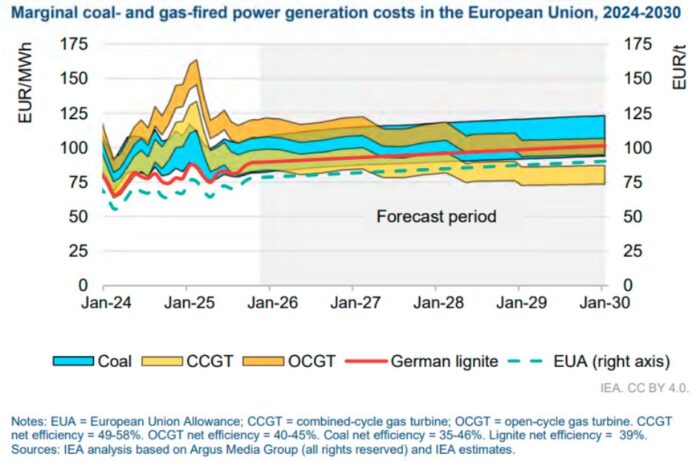
Fuel market dynamics are expected to accelerate the EU’s coal transition. European gas prices are projected to stabilise at lower levels as a global LNG glut weighs on TTF hub prices. At the same time, expectations of higher carbon prices toward 2030 are eroding coal’s competitiveness. Gas-fired combined-cycle plants maintain an advantage over coal on clean spark spreads, while lignite can only remain competitive under periods of elevated gas prices. Overall, higher effective costs for coal-fired generation continue to strengthen the economic case for coal phase-out.
Non-power coal use declines steadily
Non-power coal consumption in the European Union is estimated at around 83 million tonnes in 2025 and is forecast to decline to about 68 million tonnes by 2030. Electrification, alternative fuels and industrial decarbonisation are reducing coal use in energy-intensive sectors, with large industrial players increasingly cutting metallurgical coal consumption in favour of lower-carbon options.
Coal’s role in the EU power mix shrinks sharply by 2030
By 2030, coal’s share of EU electricity generation is expected to fall to around 4 percent. Total EU coal demand is forecast to decline to approximately 153 million tonnes, pointing to coal’s near-complete exit from the EU power system early in the next decade as policy commitments and market economics converge.
Coal demand remains higher outside the EU
In other European countries, coal consumption remains more significant. Total coal demand outside the EU is estimated at about 177 million tonnes in 2025, with coal-fired generation supplying around 16 percent of electricity. Demand in these markets is broadly stable year on year, although ageing assets and closer integration with EU power markets are reducing load factors, particularly in the Western Balkans.
Türkiye remains a key coal market
Türkiye is the largest coal-fired power generator in Europe outside the EU, with coal consumption near 115 million tonnes in 2025, down about 5 million tonnes from 2024. Türkiye has no official coal phase-out date and continues to rely on coal for market and adequacy reasons. Plans to introduce a domestic emissions trading system in 2026 to 2027 could gradually increase carbon costs for coal, although tariff incentives for domestic lignite may partially offset the impact.
Slower transition in non-EU Europe
Non-power coal use outside the European Union is projected at around 31 million tonnes in 2025 and is expected to remain broadly stable through 2030. Slower industrial decarbonisation, limited substitution of metallurgical coal and weaker carbon policy frameworks suggest a more gradual decline in coal’s role. By 2030, coal demand in non-EU Europe is forecast to fall to about 135 million tonnes, with Türkiye and the Western Balkans maintaining residual coal capacity well into the next decade.
Baburajan Kizhakedath
